
Canyon De Chelly
Canyon De Chelly (pronounced Canyon Deshay) is a National Monument - part of the National Park Service. But the land is still Navajo. Within the Canon, and the Canyon walls, are the ruins of ancient civilization - both Anasazi, and Navajo.
My desire to know Canyon De Chelly (pronounced: de shay) began more than 30 years ago when my best friend, at the time, Dennis Hamm, worked there as a National Park ranger. His stories of the place filled me with such a sense of wonder.
Three days ago I saw the Canyon for myself, and it was even more than I had imagined for all of these decades. At each, and every turn, I stood in complete awe of the landscape that surrounded me; and I could feel its sacredness fill me.
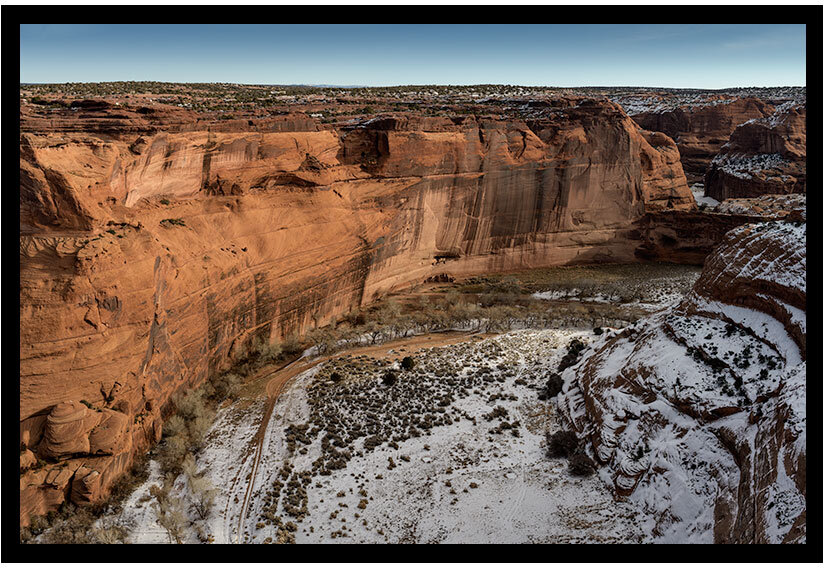
White House Overlook in Canyon De Chelly National Monument.
It was easy to imagine this canyon centuries earlier, when the Navajo roamed it freely; as the canyon itself has not changed. One is taken even further back in time as one gazes upon the cliff dwellings of the Anasazi; know as “White House."
As I drove through the National Monument I was surprised - in a pleasing way, that the Navajo people still live upon this land. Dotted throughout the area are houses. I would like to ask one of them how it feels to be living on this land of their ancestors, and to see its beauty, and sacredness still intact.
I will return to Canyon De Chelly, tomorrow, to explore it in much more depth. When I was here, the other day, I was limited because I had not yet acclimated to the altitude. But this will be one of many trips to this Canyon, and hopefully to this entire region of the Navajo people: Dine’, as they refer to themselves; which translates to “the people”.
_David
Dine'
“Dine’” which is Navajo for “The People” seemed appropriate for the working title of my newest book project, on the Navajo People. This post talks about a Navajo family to turned to ranching in 1978. But more specifically, they raise bulls for the rodeo. In recent years Freddie has begun turning the business over to his two daughters.
I came to northern Arizona to do a story about the Navajo - their history, and their way of life. As with many projects - nearly all, if I am to be honest, that deal with indigenous cultures, the going is slow - even when one has established contacts within the cultures. This time is no exception.
I arrived here with the guarantee that I would be able to tell the story of an 83 year old Navajo woman who still tends to her sheep, everyday, and still lives in the conditions of no electricity, and no running water. Heat is supplied by wood fires, but the wood must be collected in the hills. But as I was nearing my destination, I received word that the daughter, (who would be my translator), would not be available. Since the mother speaks only Navajo, the story was on hold.
But as good fortune would have it, I had another person that became available to tell their story. I was told to be there by 2:00p.m. yesterday afternoon. Just before leaving the house I received a call telling me that the youngest daughter was "getting ready" to load her bulls, for transport to another location.
I arrived just in time for the loading of the three bulls; an event that was not photographically powerful, but was great to witness. It also opened a door for another possible story within this budding project. But just as I arrived at the house, I was told that there was a bit of an emergency: the horses had escaped from the corral. Locating them, and returning them, was now the priority.
While the search went on for the horses, I had time to talk with the youngest daughter about her role in the business - that her father had started in 1976. I was also able to make a few photographs of the bulls being loaded.

Shortly after finishing, the horses were on their way back. When I saw Freddie (the father) walking across the plains, with the horses, I knew hat a great photograph was to be had. I began to make my way, on foot, towards Freddie - shooting frames along the way.

After the horses were returned to the corral, it was time to sit down with Freddie; but that was not to happen. There was a snafu that would prevent it - a very understandable snafu, indeed. Instead, Freddie and I stood outside, for several minutes, to talk informally. He told me of his ranching, and his raising of bulls - for the rodeo, which he intended to keep doing - in his partial retirement. I made tentative plans to photograph him early next week - "if" he was going out to the ranch, where he kept his bulls. It would mean that I will ned to stay on a few extra days, but well worth it if it can happen.
This is their world, that I have entered into; not my world that they have joined into. And these two worlds are very different - in the way that things unfold. To lose sight of that is to be callous, and arrogant - on my part. I believe in this story; but more so, I believe in this culture. I believe that their story needs to be told - as much for them, as for those on the outside. I believe that there is much to be learned from them - the Navajo people.
_David
Collusion Between NRA Membership and the Russians:
This post is the result of a piece that I had read, online, that sparked a grave concern - a concern that is not attached to any political affiliation…
September 30, 2019
About a week ago The September 2019 U.S. Senate Committee on Finance Minority Staff Report became public, and made its appearance immediately on social media platforms. Since this had a link to the actual report, I decided to look at it for myself.
In reading the document there are certainly illegalities, but they are the least of my concern, of which there are several. The two [concerns] that top my list are the [seemingly] unprecedented political access that has been granted to the Russian government, over the past several years. As the report states clearly, the high-ranking members of the NRA were granting access to its U.S. political contacts, in return for favors.
This should frighten every U.S. citizen. For decades the United States has gone to war, to prevent the "spread of communism". Yet now Communism seems to be the offering de jour. But it is not "Communism" that we should be afraid of. It is the undermining of our government - and thereby our way of life, by influential powers that we did not elect.
My other concern is that this, like so many other issues that are brought to light, will be used only as a pawn, for political maneuvering by the left, against the right. It will make it appearance on social media (which is has already done), have a short lifespan of soundbites, and blabbering, then disappear into the abyss that is filling with an abundance of sediment of others stories like it.
We scream about the desperate need to close our borders. Yet we are willing to turn a blind eye to a potentially far greater threat. I am reminded of a quote that my mother always reminded me of. It was made by Nikita Krushev, regarding the Soviet Union and the United States. He said (and I am paraphrasing slightly): 'We will bury you from within'
Let us stop the soundbites, and the grade school-level playground bickering, of "he did it, she did it." Instead let us regain control of our government. We can no longer afford to vote on "one issue". We must vote based on what is bets for our country, and our society, overall.
And I want to end this post with a side note, of sorts. This is NOT about the NRA, even though it is their organization that has committed these infractions. Let us not get caught up in in the bullshit of name calling. Instead, let us look at the facts, and address them - in open forums, and public meeting places. Let us bring about a positive change...
https://apps.npr.org/documents/document.html?id=6432520-The-NRA-Russia-How-a-Tax-Exempt-Organization
Racism In Our Dialog
I have noticed, probably for my entire lifetime - but, for the purpose of this writing, I would say: for quite some time;.[What] I have noticed is an aspect of our collective dialog that hints of a racism.
I have noticed, probably for my entire lifetime - but, for the purpose of this writing, I would say: for quite some time. [What] I have noticed is an aspect of our collective dialog that hints of a racism. Most times, I’m relatively sure, that this racism is unintended. In fact, I would go so far as to say that it is not even realized by the person speaking the words. But it has become ingrained minus - probably all of us, so it has become part of the grammar of our storytelling.
But I also believe, without a doubt, that there are those who incorporate these idioms into conversation because they are, indeed, backed by a conscious, and deep-rooted racism. Regardless, of the origins, I believe that it is a subject worth exploring, in the words of this post.
It was yesterday, while I was in attendance as part of a large, and very diverse gathering, that I overheard a conversation that brought all of this to mind. It was a man, of middle-age, relaying a story to two other men - also of middle-age, about an acquaintance that had been hit by a car while riding his motorcycle. The man who had been hit was, thankfully, only injured slightly.
As the story was being told - and each subsequent time it had been told, and talked about, the man telling the story used the same descriptive phrase each time: “this damn Mexican” - referring to the driver of the car that was at fault.
Another story, that was recently relayed to me, was regarding a bagger at a local grocery store. The “bagger” was referred to, in the telling of the story, as “this young African-American woman”, who had done such an awful job of bagging.
In either of these stories, the race, or the gender, was not applicable, in any way, to the meat of the story. Would the outcome of the accident, between the car and the motorcycle have been any less significant had the driver at fault been Caucasian, or Asian, or any other race? Would the experience of the shopper, having their groceries tossed without care, into the plastic bags, been any less aggravating, had the bagger been a man, or a Caucasian, or.. etc.? he answer is no, to both of these stories.
So why do we find it important, or imperative to include such details? The only answer that I can come up with is that they are part of the “norm”. They are a part of our social storytelling mechanism. But, in fact, do they not stem from a place of racism - intentional, or unintentional?
I ask this latter question, NOT as the impetus for outrage, or explosive, over-reactive dialog. But rather, I ask it to spark a civil, and honest dialog - within ourselves, as well as within an open conversation within our society. But I would also venture to propose that this is a dialog that needs to be discussed, and explored by societies the world over. It is not just an “American” problem. It is, in fact, worldwide.
_David
Lessons From a Hurricane
This morning, as I sat in my well-worn leather recliner, with the Calico cat laying across my left arm, and my right had writing thoughts in my journal - all of this part of my morning ritual when I am not on the road, I came to a stopping point. I sat for a few moments longer;
This morning, as I sat in my well-worn leather recliner, with the Calico cat laying across my left arm, and my right had writing thoughts in my journal - all of this part of my morning ritual when I am not on the road, I came to a stopping point. I sat for a few moments longer; the pages of my journal still open, but the pen now resting on the open pages. The sun was now up, and the blueness of the sky had begun to show through the still dense green foliage of the trees.
At first my reaction, albeit subtle, was that I was glad to see the blueness of the sky - a signal that the violent storms, and heavy rains of last night, had moved to other areas, or had simply exhausted themselves, elsewhere.
But then my thoughts turned to recollections of a time, not long ago, when I drove to the Gulf Coast of Florida, to experience, first hand the “authenticity” of a hurricane - in this case, it was Hurricane Michael; one of the worst in recorded history.
As I sat watching the intensity - which many in its path would refer to as its “violence”, I was in awe of the power that nature can possess. But the greatest revelation, for me, came early the next morning, as I emerged from my hotel room many miles away, in Fair Hope, Alabama, where the hurricane ignored.
As I walked from my hotel room, to the hotel’s breakfast area - about a 40 yard walk, I was abruptly struck by the extremely clear blue of the sky, and the slightly warm, but very gentle breeze that passed, nearly constantly, across my body. But what struck me, far more profoundly, was the realization that followed: Less than 24 hours earlier I sat in my Ford Expedition, not quite 200 miles away, witnessing the fury of Hurricane Michael - and moreover, the destruction and, yes, the violence. And now the skies were inviting, and the air only but a slight breeze. It was if nothing had happened the day before.
Then, later that morning, I had driven to the outskirts of where the hurricane had passed through, the day before, and the skies were the same. As I headed back westward, to Pensacola, Florida, I witnessed dozens of people surfing - taking advantage of the larger waves left by the passing storms. And one again, the skies were crystal clear, and the air calm.
My profound realization, was this: Nature, unlike humans, has no agenda, or animosity. The hurricane was not angry. It was not out for vengeance of any kind. It was not intentionally destructive. It was simply nature reacting the changes in the environment, and rebalancing itself. It just so happened that people, and property were in its path.
In ages past, things like hurricanes, tornados, volcanos, and earthquakes were considered to be a lashing out of angry gods. Sacrifices would ensue, in the aftermath, in an attempt appease these gods, and to stave off another tantrum. But I found a valuable lesson in this experience - a lesson about perception. Nature unleashed a fury, as a process for rebalancing itself. It was not “lashing out” - it had no malicious intent. It was simply doing what was natural. And all of nature - the trees, the animals, etc. did not become angry with the weather; they did not respond with retaliation. They simply adapted and moved on.
Birthplace of Mother's Day
Unbeknownst to me, before working in Grafton, West Virginia, was that there was an actual place where Mother’s Day began. This is the story of that beginning, and the history that preceded it…
February 8, 2019
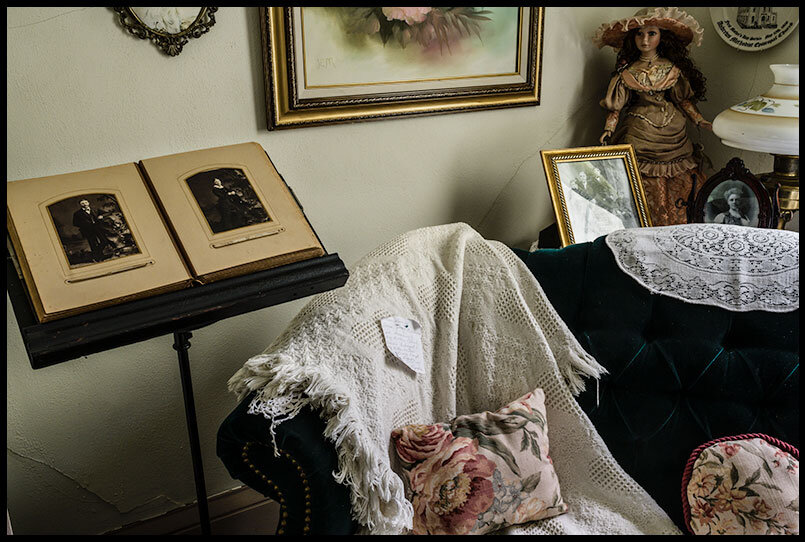
A piece of paper, attached to the quilt, gives an acknowledgement to the person who donated it.
On the outskirts of Grafton, West Virginia, at 284 Pearl Felton Lane, sits an unassuming white frame house that has found its place in history as the house of Ann Reeves Jarvis, and the birthplace of Anna Jarvis - the founder, and creator of Mother’s Day. This tiny house is now a museum dedicated to Anna Jarvis, and the entire Jarvis family. But the museum, the house, and the land surrounding it, is steeped in Civil War history, early Civil Rights, the Underground Railroad, and a history of acceptance, and human rights.
Ann Reeves Jarvis was an activist. During the Civil War Ann was on the side of the Union, geographically, but she took no actual sides in the war. In fact, it was during the Civil War that the grass roots of, what was to become Mother’s Day, had begun to grow even deeper. Ann Reeves Jarvis had created “Mother’s Day Work Clubs”, in 1858, prior to the beginning of the War. These groups were created while Ann was pregnant with her sixth child, to improve health and sanitary conditions in Taylor County, West Virginia. This was part of an existing, and growing public health movement throughout the United States. Their mission was to provide assistance, and education to families - primarily to reduce disease, which was the primary cause of infant mortality. The clubs raised money to purchase medicines, and to hire women to work with expectant mothers who were experiencing health problems.

Photographs of Union soldiers occupy a section of tis original desk in the Ann Reeves Jarvis house. Also ration tickets, and a newspaper headline adorn the desk.
When the Civil War broke out, Ann declared her neutrality, and she urged the clubs to do the same. The Jarvis house is located on what had been one of the largest Union encampments in West Virginia, during the war. Within her house Union officers drew battle plans, and engaged in strategic planning. But through it all, Ann remained neutral; so much so that when the Methodist Church proposed to have a split, into southern and a northern branches, Ann (a staunch Methodist) refused to support it. The war brought about a need for the Mother’s Day Clubs to alter their mission, to meet the changing needs brought on by the war. Under her guidance, the clubs fed, and clothed soldiers from both sides.
Near the end of the war, the Jarvis family moved to the town of Grafton, West Virginia, several miles away. Still strongly involved with the Methodist Church, Ann oversaw the construction of the Andrews Methodist Episcopal Church, which still stands along Main Street, in Grafton. Their she continued to teach Sunday School classes. Ann was also a prolific, and well regarded public speaker.
According to the recollection of Anna Jarvis - the daughter of Ann Reeves Jarvis, It was in 1876, when her mother was “praying for someone” to memorialize and honor Mother’s, during a Sunday School lesson. Then, on the first anniversary of Anna Reeves Jarvis’ death, her daughter, Anna Jarvis met with friends to discuss creating a memorial service to rememberer mother for the next year. In May 1907, a private service was held in honor. In 1908, Anna Jarvis organized the first official observance of Mother’s Day - which fell near the anniversary of her mother’s death. This observance was held at the Andrews Methodist Episcopal Church in Grafton, West Virginia.
After years of trying to have Mother’s Day recognized as an official holiday, in the United States, she realized success in1914, when U.S. President Woodrow Wilson signed a congressional resolution declaring that the second Sunday in May be the national Mother’s Day, and called for all Americans to recognize this day by displaying the American Flag.
The Andrews Methodist Episcopal Church still stands along Main Street, in Grafton, West Virginia. But now it is the official Mother’s Day Shrine.
The Anna Reeves Jarvis house, has been established as a museum dedicated to the history of Ann Reeves Jarvis, as well as Anna Jarvis.

A crawl Space, hidden beneath the rope rug that covers a large portion of the kitchen floor, in the Anna Reaves Jarvis house.
A guided tour of the house gives a great window into the importance of the Jarvis family, but especially the importance of Anna, and her mother. The tour begins in the kitchen. Underneath the large rope rug is a small door in the floor. During the time of slavery, and the Underground Railroad, the tiny crawlspace, beneath the kitchen floor, was a space used to hide runaway slaves until they could be joined with the Railroad. Relics, and documents from the Civil War - as it pertained to life within, and surrounding the Jarvis house, is also on prominent display.
On the second floor, of the three story house, is a room devoted to dolls. These dolls were not part of the Jarvis family, but they represent - in a very real way, the continuing legacy of Ann Reeves, and Anna Jarvis: to honor, celebrate, and keep alive the dedication of mother’s the world over. Each of the dolls, that occupy this one room, have come from, or in honor of, mothers from around the world - and from a huge diversity of cultures.
Olive Ricketts, who is the curator of the Ann Reeves Jarvis House, began receiving dolls - either in person, or by mail, with notes attached. These dolls were being donated, unsolicitedly, to the Ann Reeves Jarvis House - in many cases so that they (the dolls) had a meaningful place to continue out their lives now that the original owners had died. Each doll is representative of “a mother” in some profound way. This is one of Olive’s charges to keep the memory, and spirit of Ann Reeves Jarvis, as well as Anna Jarvis alive - as well as the true spirit of Mother’s Day.
For tour information contact: Olive Ricketts at ajhouse26354@yahoo.com
The Horse From Good Intentions:
This morning, as I drove from Pittsburgh back to Grafton, West Virginia, I decided to get off the Interstate and explore the town of “Prosperity.” For decades the name has intrigued me - like so many other names of towns across America, with names that make a statement …
August 4, 2019
This morning, as I drove from Pittsburgh back to Grafton, West Virginia, I decided to get off the Interstate and explore the town of “Prosperity.” For decades the name has intrigued me - like so many other names of towns across America, with names that make a statement - a statement of intent by those who settled the town. While trying to find Prosperity I first came upon the town of Amity; (Amity: Friendship, friendliness, harmony, harmoniousness, understanding, accord, cooperation, companionship, amicableness, goodwill, cordiality, warmth.)
Only one road passes through Amity: Highway 19. On either side of the highway are houses, constructed just at the road’s edge, dating back many years - although doubtful that they are the original structures of the settlement. Two churches exist; a Methodist, and a Presbyterian - the Methodist being the oldest: built in 1867. The Presbyterian was built in 1874.
Continuing on, I finally arrived in Prosperity - named after “the optimism of its settlers.” The town was much like Amity, although is a somewhat better state of upkeep. The houses were set against the road, on both sides - some with small front yards. The town sets at the ‘Y’ of Highways 18 and 221.
Having left Prosperity behind, I made a few wrong turns and ended up, as best I can figure, near the town of “Good Intention”; seven houses. a Presbyterian Church, and a barn, on West Union Trace. This “barn”- a well-weathered barn that had seen many years come and go, was at the end of West Union Trace, which appeared to be the main road through the town.

As if framed like a photograph on the wall, a reddish-brown horse, facing to the left, stood in the large open doorway along the side of the barn. It was the only sign of life within the town. Each time that I drove through, which was a total of three times - nearly back to back, there was not a person - or even a dog or a cat in sight. It was as if all life had vanished, or had become sequestered within the outer walls of the houses that covered the hilly landscape.
With each of these three towns I wondered if their namesake ever became a reality. Did “friendship and harmony" become a way of life in Amity? Did those who resided in “Prosperity” achieve the prosperity of their new life? And with the town of “Good Intent” - the least difficult to achieve, how did things pan out?
Waffle House
Just after I moved to Nashville, I became aware of the Waffle House restaurants. At first I considered them as a typical “greasy spoon”, but quickly came to realize that they are much more…

May 12, 2019
When I moved to The South, more than a decade ago, I discovered Waffle House. Initially, for me, it was nothing more than a restaurant that adorned the highways, and byways of the southern states. But as I began to travel these roads I found myself stopping at these somewhat ionic restaurants. At first I was unimpressed. But then I became hooked.
At first I think it was the “sameness”: the sameness of the menu, the sameness of the food itself, and the sameness of the atmosphere. Eventually I began to realize that there was also a “sameness” to the people who ate there, as well as the people who worked there. The is a culture to the Waffle House Restaurants - and it is a subculture of America… a “melting pot of sorts.
In every Waffle House there are “the regulars” and “the transients”. And regardless of the geographic locations, there are similarities that connect them all - in both categories. But what I have come to realize, over time, is the culture of those who work at the Waffle Houses. On the surface, of course, is that language - one that I have come to speak when ordering: "pull one sausage”, hash browns scattered and well done. But below the surface is a dedication - and a competitiveness, especially among the cooks. From time to time I have overheard them in conversation, talking about how many order they put out on a particular shift. And how the cook at store #537 holds the record for his daily shift. There are bragging rights, as the experienced cooks teach the newbies how to meet the standards - and demands. There is a Pride.
But at night, generally beginning around midnight to 1:00a.m., the culture of the Waffle House changes - much like the creatures of the sea change from day to night. This culture is primarily those coming from clubs, and concerts. Some are patrons of the clubs, while others are performers who just finished a gig. For the most part they are regulars - as is evident by the familiarity of those waiting on them. And the conversations are not limited, as they are during the daytime shifts, between customers. During the nighttime hours the conversations are engaged in by patrons and employees alike - seamlessly flowing back and forth. There are no barriers, except for the physicality of the counter that separates the restaurant from the cooking area. But the conversations flow easily over them, as if they were not there at all.
